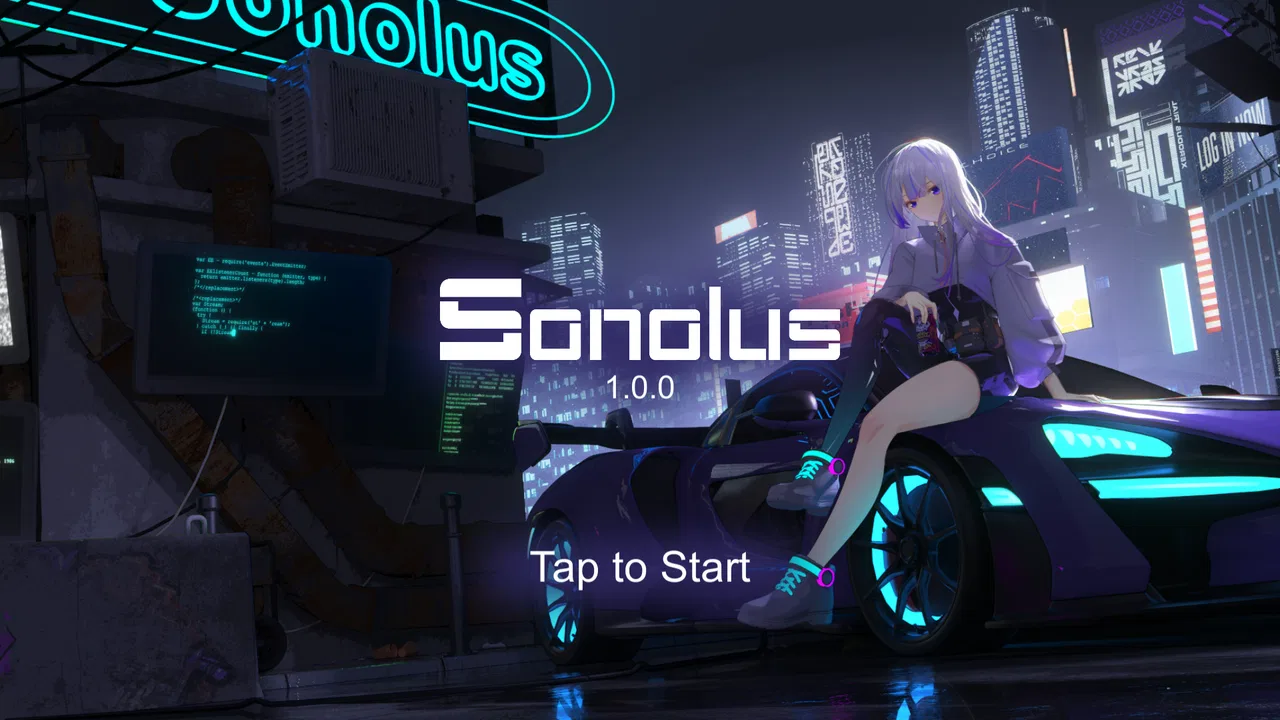
Sonolus
- 3.8
- Rating
- 1.00M
- Installs
- Free
- Price

 Analysis by App-foxy
Sonolus is a music game from Macau FosFenes Technology that aims at a more flexible kind of rhythm-game experience than the usual tap-along release. I spent time looking at where it fits, how its free access affects its value, and what sort of player is likely to enjoy it. My overall impression is that it is more interesting for curious rhythm-game fans than for someone who simply wants a polished, self-contained song list.
The first thing worth knowing is that its store summary calls it a next-generation rhythm game, while the short description is simply “Sonolus.” That leaves the app feeling less immediately explained than mainstream alternatives. You need to approach it with some patience rather than expecting the opening screen to answer every question for you. Once you understand that this is a music-focused game built around a broader concept, its appeal becomes easier to judge.
How Sonolus feels in everyday use
I find Sonolus most revealing when I treat it as part of an ordinary routine rather than judging it from a quick first impression. A short, focused session can show whether its layout and rhythm play feel manageable, while a distracted setting may expose different hurdles. That everyday test leads naturally to a closer look at how readability and navigation shape the experience.
You May Also Like

 Blood Strike: 2.5 Anniversary
Blood Strike’s Loadouts Turn Every Drop Into a Tactical Gamble
A close look at Blood Strike’s custom loadouts: how fast access to signature weapons reshapes its battle royale rhythm, rewards preparation, and narrows the gap between fights.

 Pandora - Music & Podcasts
Pandora’s Music Is Easy to Start, but Harder to Recover
Pandora’s strength is its low-effort path from a seed to a station. Its weak spot is how much confidence it asks you to place in connection, setup, and quiet recovery.

 8 Ball Pool
 Is Built on Rivalries, Rematches, and Routine
A close look at the rivalries, rematches, shared routines, and unanswered safety questions that turn a quick pool match into a persistent mobile community.

 Samsung Music
’s Quiet Strength Is Playing What You Already Own
Its reach comes less from spectacle than from dependable access to a personal library. That simplicity is both the app’s strongest retention engine and its ceiling.

 AccuWeather: Weather Radar
AccuWeather Review: A Quick, Clear Forecast for Everyday Decisions
For everyday plans, the best forecast is the one you can understand quickly. AccuWeather makes rain timing, radar, and local conditions easy to act on, with a few trade-offs.

 Hill Climb Racing
Why Hill Climb Racing Still Turns Crashes Into One More Run
A tiny car, a bumpy hill and one more upgrade: Hill Climb Racing keeps resurfacing because its simple chaos makes every near-miss feel personal.
More From Our News Desk
View All News


A free starting point with a clear financial boundary
The game is free to install, which makes trying it straightforward. You do not need to commit money before finding out whether its style suits you. That matters here because Sonolus is not aimed only at casual players who want a familiar arcade loop; the experience asks you to explore and form your own opinion.
There are in-app purchases priced from $4.99 to $49.99 per item. I would treat those as optional spending rather than part of the basic entry cost. The important distinction is that free access gives you a chance to understand the game, while paid value depends on whether what you find inside matches your preferred way of playing. I would not buy anything immediately. I would first check how much of the experience I can use comfortably without paying and whether I expect to return regularly.
That approach is especially sensible because the game has a 3.6 average from around 3.6 thousand ratings. The score suggests a mixed reception rather than universal approval, so the free starting point is a genuine advantage. It lets you test the controls, presentation, and overall rhythm-game structure instead of relying on a headline or a high rating alone.
What makes the concept different
Traditional mobile music games usually explain themselves quickly: choose a song, watch notes move toward a target, and tap in time. Sonolus feels less like a single tightly packaged playlist and more like an environment for rhythm-game content. That difference can be exciting, but it also changes what “easy to use” means.
If you enjoy discovering how a game is organized, comparing different chart styles, and spending time with the parts surrounding the actual notes, you may find more depth here than in a basic one-session rhythm title. If you only want a predictable sequence of songs with minimal setup, the same flexibility may feel like extra work.
My practical advice is to judge the game in two separate stages. First, play long enough to decide whether the timing and input feel comfortable. Then explore the surrounding options and content flow. A rhythm game can have excellent ideas but still fail for you if the interface makes choosing or returning to those ideas frustrating.
Useful habits for new players
One useful habit is to begin with shorter sessions. Rhythm games can make small timing problems feel bigger after several attempts, especially when you are still learning how Sonolus presents information. A few focused plays will tell you more than an extended first sitting where fatigue makes every chart seem worse.
I also recommend changing only one variable at a time when you are learning. If a chart feels difficult, do not immediately blame your reflexes. Check whether the issue is the note presentation, the speed at which information arrives, or the way you are reading the lane. Keeping the rest of your setup consistent makes it easier to identify what actually needs practice.
Another non-obvious trade-off is that flexibility can shift some responsibility onto the player. In a conventional music game, the developer usually controls the full path from song selection to difficulty balance. With Sonolus, the experience is more dependent on how willing you are to browse, test, and settle into the content that works for you. That is a strength for explorers, but not necessarily for people who want a curated evening pastime.
How it compares with familiar rhythm games
Compared with a standard mobile rhythm game, Sonolus is less about instant spectacle and more about the surrounding ecosystem of play. The usual alternative is easier to understand in the first minute: it often has a prominent song catalog, a clear progression route, and a familiar reward loop. Sonolus is the better choice when you value experimentation and discovery over a tightly guided campaign.
Compared with a simple offline tapping game, it also asks for more attention from the user. The simpler option wins for a quick commute or a few idle minutes because there is little to learn. Sonolus becomes more attractive when you want a music game that can hold your interest beyond repeating the same introductory pattern.
That comparison also explains why I would not recommend switching blindly from a favorite rhythm title. If your current game already gives you the exact song selection, difficulty curve, and progression you want, Sonolus may feel like a side project rather than a replacement. Its value is strongest when you are looking for a different structure, not when you merely want another copy of the same formula.
Performance, patience, and the first week
The listed minimum operating-system requirement is Android 7.1, so the game is accessible to people using older compatible Android devices. That does not automatically mean every phone will deliver the same experience, particularly in a timing-sensitive game. For serious play, touch response and consistency matter more than simply being able to install the app.
I would use the first week as a trial period rather than making a purchase decision on the first day. Notice whether you keep returning without needing a reward to pull you back. Notice whether the interface becomes easier after several sessions. Most importantly, notice whether you are enjoying the act of learning the game or merely trying to work around it.
For an everyday scenario, imagine a player with a short evening break after work. If that player wants to open a familiar song list, play two tracks, and close the app, a conventional rhythm game may be more satisfying. If the same player enjoys spending that break exploring different ways to play and gradually building a personal routine, Sonolus has a stronger case. The difference is not raw quality; it is the amount of curiosity the game expects.
Who is likely to get the most from it?
I see the best fit in players who already understand rhythm-game basics and want something that feels less locked into one narrow presentation. Music-game enthusiasts, chart explorers, and people who enjoy learning a system from the inside are the natural audience. They are more likely to see the extra flexibility as an invitation rather than a barrier.
It can also suit someone who wants to experiment without paying at the door. Since the game is free to start, you can evaluate the core experience before deciding whether any purchase is worthwhile. That is a better arrangement for cautious players than a paid download that reveals its limitations only after installation.
On the other hand, I would steer away from it if you want a fully guided progression path, a large amount of immediately obvious content, or a game that explains every part of itself through a polished tutorial. I would also skip it if you dislike spending time navigating a music game before reaching the exact activity you wanted.
Readability, navigation, and different ways of engaging
For me, the important usability question is not simply whether the notes can be read, but whether I can make sense of the game before a session turns into guesswork. Sonolus asks for more interpretation than a tightly guided song-list game. I would take a moment to learn the layout and content flow before judging the play itself; otherwise, confusion about where to go can be mistaken for difficulty with the rhythm.
That distinction matters for players who prefer to learn by reading, those who need a calmer pace, and anyone using a small screen. A chart that looks busy can be harder to parse when you are tired or distracted, even if you can physically tap accurately. I recommend testing a brief session in the setting where you expect to play, rather than assuming that a comfortable experience at home will transfer unchanged to a crowded commute.
Motor and sensory considerations
Rhythm play depends on repeated, well-timed touch input, so it can be demanding for anyone with limited dexterity, hand fatigue, or difficulty making quick movements. I would not assume that a different playing style automatically removes that demand. A useful personal test is to try a short session and notice whether the required motions remain comfortable, not just whether you can finish a chart once.
Sensory comfort deserves the same practical check. Music games can ask players to coordinate sound and moving visual cues, and that combination may be tiring for some people. If you are sensitive to rapid visual activity or loud audio, try playing in a comfortable environment and stop when concentration starts to slip. I would choose a different, less timing-intensive game if the basic rhythm loop causes discomfort rather than enjoyment.
Where access still takes effort
The main barrier I noticed in the concept is the amount of initiative it expects. Players who need explicit guidance, predictable navigation, or a clearly signposted route may have to work harder to settle in than they would with a conventional, curated music game. This is not a judgment about anyone’s ability; it is a design trade-off that makes self-directed exploration central to the experience.
It also means the game may be a poor fit when someone else needs to help you choose what to play quickly, or when you have only a minute to get started. I would not treat the Everyone content rating as a promise that every interaction will feel equally approachable to every player. Age suitability and ease of use are different questions.
What the rating and audience size tell me
Sonolus has passed one million installs and carries an Everyone content rating. That combination tells me it has reached a broad audience and is positioned as an accessible game rather than a niche title restricted by age. It does not guarantee that the design will suit everyone, though. A general audience can still have very different expectations about controls, song access, and ease of use.
The rating of 3.6 from around 3.6 thousand ratings reinforces that point. I read it as a reason to try before spending, not as a reason to dismiss the game. A mixed score can reflect a product with a distinct identity: players who connect with the concept may appreciate it, while those expecting a conventional rhythm package may be disappointed.
The game was released on July 14, 2025, and the current version is 1.1.0. That places it in a relatively early stage of its life compared with long-established music games. I would therefore judge it partly on what it offers now and partly on whether I am comfortable with a product that may still feel like it is finding its clearest shape.
Where the value is strongest—and where it weakens
The strongest value comes from the combination of free entry and a concept that can appeal beyond a single repetitive loop. You can investigate it without paying, and players who enjoy discovery may find reasons to keep returning. For them, the game offers more than a disposable tapping toy.
The weaker side is that flexibility is not automatically content value. A broad framework can be less satisfying than a carefully curated catalog if you want immediate variety with no searching. Paid items may make sense for a committed player, but the higher purchase range makes it even more important to establish a personal reason to spend. I would only pay after I had identified exactly what extra value I was receiving.
There is also a time cost. Learning how the game wants to be used may be part of the fun, but it is still a cost. Someone with limited free time may reasonably prefer a simpler alternative, even if Sonolus is more ambitious. In my view, that is the central trade-off: you exchange some instant clarity for a potentially richer and more exploratory rhythm-game experience.
My recommendation
My recommendation is to download Sonolus as a free trial, not to treat it as an automatic purchase. Give it several focused sessions, test whether its presentation feels natural, and see whether you enjoy exploring rather than being led. If the game’s broader approach matches your interests, the free entry makes that discovery low-risk, and later spending can be considered on its own merits.
I would recommend it to experienced rhythm-game players who want something different, especially those comfortable learning through experimentation. I would not recommend it as the first choice for a player who wants a straightforward, highly curated music game with an obvious path from the opening screen.
In the end, Sonolus is most convincing when you value possibility more than convenience. Macau FosFenes Technology has made a music game that attracts attention because it does not feel like a routine copy of the standard mobile formula. At the same time, its mixed average means you should approach it with realistic expectations. Try the free version, keep your spending deliberate, and let your own play habits decide whether its unusual structure is a strength or simply unnecessary friction.
FAQs for Sonolus
01What is Sonolus and what does it offer?
Sonolus is a versatile rhythm game engine available for both Android and iOS. It allows users to play, create, and share their own rhythm game levels. With its growing community and vast library of user-generated content, Sonolus offers endless possibilities for customization and creativity, making it a unique platform for rhythm game enthusiasts.
02Is Sonolus free to download and use?
Yes, Sonolus is free to download and use on both Android and iOS devices. While the core features are accessible without cost, there may be optional in-app purchases or ads that support the developers. These do not hinder the primary experience but can enhance your interaction with the app.
03How user-friendly is the level creation tool in Sonolus?
Sonolus provides a comprehensive level creation tool that is surprisingly user-friendly, even for beginners. It features intuitive drag-and-drop mechanics and detailed tutorials to guide users through the process. Whether you're new to game design or an experienced creator, the platform offers flexibility and ease of use to bring your ideas to life.
04Can I play Sonolus offline?
While Sonolus requires an internet connection to download new levels and updates, you can play downloaded levels offline. This feature is particularly useful for users who want to enjoy their favorite rhythm challenges without needing a constant internet connection, making it ideal for on-the-go gaming.
05What kind of community support does Sonolus have?
Sonolus boasts an active and supportive community where users can share their creations and exchange feedback. There are forums and social media groups where players can ask questions, share tips, and discuss new updates. This vibrant community enhances the gaming experience by fostering collaboration and continuous learning.
Pros
- Highly customizable sound engine.
- User-friendly interface for beginners.
- Wide variety of sound effects.
- Low latency ensures smooth playback.
- Open-source
- promoting community growth.
Cons
- Limited built-in samples included.
- Requires external plugins for expansion.
- Not optimized for older devices.
- No integrated tutorial for newcomers.
- May drain battery on prolonged use.

Sonolus
Gallery